

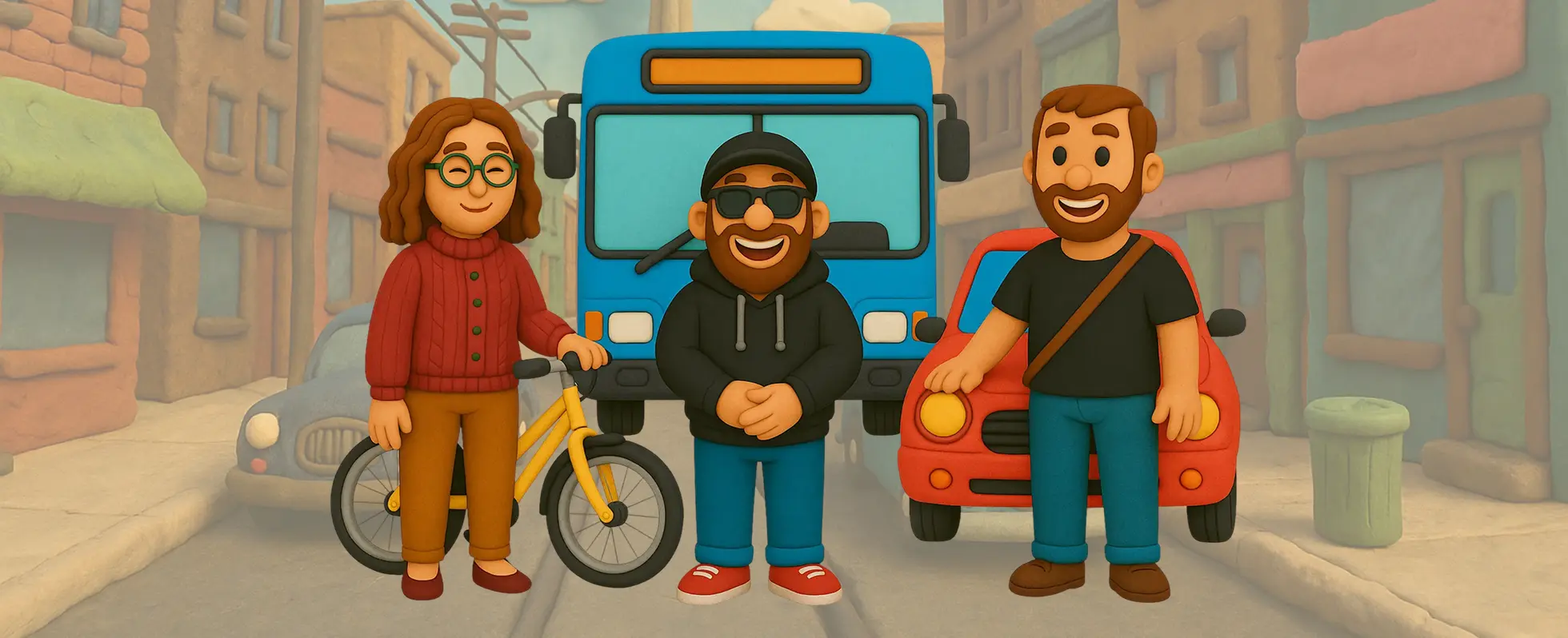
Living in Toronto forces almost everyone to answer one existential question at least once a week: “TTC or drive?” There is no universally correct answer; only the one that will ruin your morning the least. With ridership rebounding to nearly 440 million trips projected for 2025, up from 420 million in 2024 the TTC is busier than ever, carrying the equivalent of 26 lanes of traffic on Line 1 alone. But Toronto's traffic woes persist, with the city ranking 95th globally in congestion (8th in North America) per the TomTom Traffic Index 2024, where drivers lose about 45-50 hours annually to jams. Let's break it down with fresh stats.
The Car: Freedom with a Hefty Price Tag
Pros
- Door-to-door comfort, especially in -20 °C with windchill or when it’s pouring sideways.
- Faster on paper for almost any trip outside of rush hour. The average one-way car commute in Toronto clocks in at 24.7 minutes nationally (higher in the GTA at ~30-35 minutes), compared to 44.1 minutes for public transit. Example: Scarborough to Mississauga still takes ~30–40 min by car vs 90–120 min on transit.
- You control the temperature, the music, and whether someone eats a durian next to you.
- Great when you have kids, hockey bags, Costco runs, or live in areas the TTC forgot exist (parts of North York, Etobicoke, Scarborough).
Cons
- Money. The average monthly cost of car ownership in Canada hit $1,370 in 2025, but in Toronto it's steeper: insurance averages $200–$450/month for drivers under 40 (up 11% from 2024 due to rising claims), parking $200–$400/month downtown, gas ~$275/month at $1.65/L for 20,000 km/year, plus maintenance and 407 tolls you swear you’ll never take but always do — totaling $800–$1,500/month easily.
- Traffic is objectively worse than pre-pandemic. Toronto ranks 17th globally for congestion per INRIX 2023 data (with 2024-2025 trends holding steady), turning your 20-minute Google Maps estimate into comedy — drivers lose 45+ hours yearly, costing the economy billions. The Gardiner's eternal construction and King St. "improvements" don't help.
- Parking is a war crime. Downtown office spots are $300–$450/month if you’re lucky; street parking requires a PhD in deciphering signs and a sacrifice to the parking gods.
- Winter. Even with winter tires, one snowfall turns the city into a demolition derby.
- Environmental hit: Cars account for 23% of Toronto's GHG emissions (15.5 MT total in 2022, with transport at 33%), and solo driving emits far more per person than transit.
Real-life math (2025 prices, North York → Financial District round-trip):
- Gas + parking + insurance apportion: ~$35–$45/day
- TTC monthly Presto pass: $156 → ~$7.50 per workday (or $123.25 with Fair Pass discount for low-income riders). Even if you drive only 12 days a month, the car is still 3–4× more expensive.
Public Transit (TTC + GO): Cheaper, Slower, Soul-Crushing at Peak
Pros
- Cost. $156 adult monthly pass (or $143 if loaded early; $123.25 via Fair Pass). That’s it. No gas, no parking, no insurance tears — saving ~$1,000+/month vs. driving.
- Predictability… sometimes. Line 1 and Line 2 run every 2–5 min at peak, with subway ridership at 181 million in 2024 (projected higher in 2025). GO Lakeshore lines are genuinely fast if near a station.
- You can work, doomscroll, or nap instead of raging at the driver who brake-checked you on the 401.
- Environmental virtue points: Riding TTC cuts your GHG emissions by 79% vs. driving a car; transit overall avoids 93 tonnes of CO2 per electric bus/year, and the fleet's shift to hybrids/electrics saved 69 million liters of diesel since 2017. By 2040, TTC aims for zero-emission buses.
- After a couple of beers you’re not the problem; MADD approves.
Cons
- Crowding. Morning subway from Finch or Kipling feels like a Tokyo salaryman simulation, except everyone is angry and smells like wet timbits. Weekday ridership hit 76% of 2019 levels in early 2024, but peaks strain capacity.
- Reliability is a myth. Unplanned delays totaled 93+ hours in July 2025 alone (51% from external issues like track intrusions), with "bunching" (multiple vehicles arriving together) plaguing dozens of routes. Weather, signals, and construction (80% of 2025 with disruptions) turn 35-minute commutes into 90+. On-time performance: 90%+ for subways, but surface routes lag.
- Last-mile problem. If your home or office is more than a 10–15 min walk from a station/stop, you’re adding serious time or paying for Uber anyway.
- Winter again. Waiting 12 minutes for a delayed 501 streetcar in February while the app says “2 min” is a special kind of torment, exacerbated by 2025's brutal storms causing multi-day shutdowns.
- Safety perception. Late-night buses and some stations feel sketchy (though statistically violent incidents remain rare).
The Hybrid Sweet Spot (Most Torontonians Eventually Land Here)
- Own a car for weekends, Costco, cottage trips, moving IKEA furniture.
- Use TTC/GO for daily downtown or midtown commutes, where 70% of trips are now zero-emission.
- Bike + transit in shoulder seasons (May/June and Sept/Oct are heavenly; Bike Share hit 6 million trips in 2024).
- Car-share (Communauto, Turo) or occasional Zipcar when you really need one downtown.
Toronto in 2025 is still a city where the “right” choice is painfully contextual. With TransformTO aiming for net-zero by 2040 (targeting 45% emissions cut by 2025), shifting to transit could remove the equivalent of 650,000 gas cars from roads annually. Most of us choose a balance: using public transport during the week and driving a car on the weekends.
What’s your poison? Drop your commute horror stories in DM; misery loves company.
Verdict (It Depends on Where You Live and What You Value)
Drive if:
- You live in the suburbs with garbage transit (e.g., parts of Scarborough, Etobicoke, Vaughan, Markham)
- You have young kids or mobility issues
- Your job has irregular hours or multiple sites
- You make enough money that $12–15k/year on a car doesn’t hurt (and you're okay with 23% of city emissions from vehicles)
Take transit if:
- You live within ~1 km of Line 1, Line 2, or a GO station
- You work 9-to-5 downtown or along the subway spine
- You’re under 35 and still have student debt trauma
- You value your sanity over the illusion of speed, and want to slash emissions by 79%